

XAT 2025 – Verbal & Logical Ability
-
Q1. Grammar
Read the following sentences carefully.
A. There are less cars on the road today.
B. She is nicer than her sister.
C. I have been here from Monday.
D. I know how to swim.
E. She is the girl that won the case competition.
F. The media are divided on the issue.
Which of the following options contains only grammatically CORRECT sentences?- B, C & E
- A, D & E
- D, E & F
- A, D & F
- B, D & F
Correct Option: Choice ERationale: The question asks for the option containing only grammatically correct sentences. Sentence B (She is nicer than her sister) is correct. Sentence D (I know how to swim) is correct. Sentence F (The media are divided on the issue) is correct; ‘media’ is the plural of ‘medium’ and takes a plural verb in formal usage. Thus, the set B, D, and F is correct. Sentence A is incorrect because ‘less’ is used for uncountable quantities, while ‘fewer’ should be used for countable nouns like ‘cars’. Sentence C is incorrect because ‘from’ is generally used to indicate a starting point in time for future or general tenses, whereas ‘since’ is required for the present perfect continuous tense (I have been here since Monday). Sentence E is stylistically less preferred because ‘who’ is the standard relative pronoun for people, not ‘that’, although this rule is sometimes flexible, combined with errors in other options, it confirms the elimination. -
Q2. Grammar
Read the following sentences carefully.
A. The dean asked for additional funding.
B. The boss discussed about the new project with his team.
C. Radhika is good in data interpretation.
D. Neil is transitioning into a new phase of life.
E. Rajat emphasized on the need for consistency in XAT preparation.
F. This car is superior to the previous one in terms of efficiency.
Which of the following options contains only grammatically CORRECT sentences?- A, D & F
- A, B & C
- B, C & F
- C, E & F
- B, C & D
Correct Option: Choice ARationale: Sentence A (The dean asked for additional funding) is correct. Sentence D (Neil is transitioning into a new phase of life) is correct. Sentence F (This car is superior to the previous one) is correct; ‘superior’ is always followed by ‘to’, not ‘than’. Sentence B is incorrect because ‘discuss’ is a transitive verb and does not take the preposition ‘about’ (discussed the new project). Sentence C is incorrect because the correct idiom is ‘good at’, not ‘good in’. Sentence E is incorrect because ’emphasize’ is a transitive verb and does not take the preposition ‘on’ (emphasized the need). -
Q3. Fill in the blanks
Read the following sentences carefully.
When each_________________ generation grows up, it looks down on the next as if we all forget what it feels like to be______________. When most____________ think about their own youthful indiscretions they do so with a wink and a laugh. But when the same people think about those in today’s generation doing something similar, they _________________sound the alarm about a decline in morality in next generation.
From the options below, choose the one that meaningfully fills up the blanks.- preceding, succeeding, folks, cautiously
- young, young, seniors, carefully
- successive, young, adults, hypocritically
- succeeding, next, people, naturally
- old, older, youngsters, sincerely
Correct Option: Choice CRationale: The context describes a cycle of generations judging one another. The first blank requires a word describing the generation following the previous one over time, for which ‘successive’ fits best. The second blank refers to the state of the current generation in the past, which is ‘young’. The third blank refers to the people doing the looking down now, which are ‘adults’. The final blank describes the irony of criticizing behavior one engaged in oneself, which is ‘hypocritically’. Choice A uses ‘preceding’ which implies the generation before, contradicting the flow of ‘growing up’ and looking at the ‘next’. Choice B uses ‘seniors’ which is possible but ‘carefully’ does not capture the ironic tone of the wink and laugh. Choice D uses ‘naturally’ which misses the critical tone implied by the ‘wink and a laugh’ contrast. Choice E uses ‘sincerely’ which contradicts the context of having done the same things. -
Q4. Parajumbles
Read the following statement carefully.
A. Whatever that might be on Europa—far from the Sun, and beneath kilometres of ice—it will not be sunlight.
B. The final ingredient for a habitable world is a source of energy for life to exploit.
C. On Earth almost every living thing ultimately depends on photosynthesis for its energy, including the rich ecosystems in the ocean depths, discovered in the 1980s and which helped the idea of life on Europa gain a foothold.
D. Their inhabitants do not benefit from sunlight directly, but their metabolisms are powered by chemicals created in the photosynthesising, oxygen-rich surface oceans far above.
E. That is a bit of a problem.
Fill in the blanks meaningfully, in the above statement, from the following options.- E, D, B, C, A
- B, A, E, C, D
- C, E, B, A, D
- D, E, C, B, A
- A, B, E, D, C
Correct Option: Choice BRationale: The paragraph discusses the requirements for life on Europa compared to Earth. Statement B introduces the general requirement: a source of energy. Statement A connects to Europa, stating that whatever the energy is, it won’t be sunlight. Statement E comments on this limitation (“That is a bit of a problem”). Statement C explains why it is a problem by contrasting it with Earth, where life depends on photosynthesis. Statement D concludes the thought by describing the specific adaptation of Earth’s deep-ocean inhabitants (mentioned in C) as an analogy or solution for life without sunlight. The sequence B-A-E-C-D flows logically from general principle to specific problem to comparative example to solution. Other options fail to establish the logical flow. For instance, Choice A starts with ‘Whatever that might be’, which lacks an antecedent context provided by B. Choice C starts with Earth, which is a supporting example, not the main topic introduction. -
Q5. Critical Reasoning
Read the following statements and answer the question that follows.
Employees complaining about mundane tasks are often ignored. There is a listlessness that settles around them. A bored employee may continue to produce good results, but that can also be because the tasks are repetitive, and the outcomes are expected.
Which of the following options can be BEST inferred from the passage?- Good performance makes organizations overlook their employees’ state of mind.
- A bored employee must be a bad performer for the organization to take notice.
- Boredom is a serious problem that needs immediate attention.
- Mundane tasks create listlessness around good performers.
- Listlessness settles around good performers who are bored.
Correct Option: Choice ARationale: The passage states that complaining employees are ignored and listlessness settles around them, but if they produce good results (potentially because tasks are mundane), the organization is satisfied. This implies that as long as the performance is good, the organization does not concern itself with the employee’s boredom or mental state. Choice B is incorrect because the passage explicitly states a bored employee may produce good results. Choice C is a recommendation not found in the text. Choice D and E mix up the cause and effect; listlessness is a result of the situation, not necessarily the cause of the performance, and the passage focuses on the employer’s reaction (ignoring them). -
Q6. Critical Reasoning
Read the following paragraph and answer the question that follows.
No man knows how bad he is till he has tried very hard to be good. A silly idea is current that good people do not know what temptation means. This is an obvious lie. Only those who try to resist temptation know how strong it is. After all, you find out the strength of the German army by fighting against it, not by giving in. You find out the strength of a wind by trying to walk against it, not by lying down. A man who gives in to temptation after five minutes simply does not know what it would have been like an hour later. That is why bad people, in one sense, know very little about badness — they have lived a sheltered life by always giving in.
Which of the following options can be BEST concluded from the passage?- Unless we are put to test for our beliefs, we do not know what our true beliefs are.
- To claim to know anything we must apply it in a situation and then judge ourselves.
- Most of the population does not know what being bad or being good actually is.
- To claim to be good people, we should know what temptation means.
- How we label ourselves depends entirely on how much we have fought for that label.
Correct Option: Choice ARationale: The passage argues that one cannot know the strength of a force (like the German army, wind, or temptation) without fighting against it. Similarly, it suggests one does not know how ‘bad’ or ‘good’ they are without trying hard to be good (resisting temptation). This aligns with the conclusion that true beliefs or nature are only revealed when tested. Choice B focuses on ‘judging ourselves’ which is secondary to the knowledge of the self gained through resistance. Choice C is a generalization about the population not supported by the text. Choice D restricts the conclusion too narrowly to just ‘temptation’. Choice E focuses on ‘labeling’, which is not the core theme of self-discovery through struggle. -
Q7. Parajumbles
Read the following paragraph and answer the question that follows.
A. The treaty tests of a budget deficit no bigger than 3% of the GDP and a public debt converging towards a ceiling of 60% of a GDP seemed impossible for Italy to pass by 1999.
B. That Belgium also had a public debt above 100 percent of GDP helped, as did a special euro tax Mr. Prodi introduced.
C. Into the uncompromising environment came the first of a series of external shocks. One of the earliest was entry into the European single currency, the euro, in 1999.
D. But when it became clear in 1997 that Spain was determined to join from the start, Romano Prodi, then Italian prime minister, decided that Italy, as a founder member of the bloc, must be there too.
E. Germany had more or less designed the 1992 Maastricht treaty’s convergence criteria to keep out a profligate, chronically indebted Italy.
Which of the following sequences is the MOST logically ordered?- E, D, B, A, C
- C, B, D, E, A
- A, B, C, D, E
- E, A, B, C, D
- C, E, A, D, B
Correct Option: Choice ERationale: Statement C sets the context of ‘external shocks’ and the introduction of the euro in 1999. Statement E explains the barrier to entry (Germany’s strict criteria) designed to keep Italy out. Statement A follows by describing Italy’s specific economic difficulty in passing those tests. Statement D describes the political motivation (Spain joining) that pushed Prodi to ensure Italy joined. Statement B provides a supporting detail about how Italy managed it (referencing Belgium’s debt situation). The sequence C-E-A-D-B follows a chronological and logical narrative of the challenge and the reaction. Choice A starts with the treaty tests without the context of the euro shock. Choice B starts with Spain’s determination, which lacks the background of the criteria. Choice C places the euro entry introduction (C) in the middle, disrupting the flow. -
Q8. Visual Interpretation
Observe the cartoon below carefully and answer the question that follows.
(Cartoon by Tom Toro, originally published in The New Yorker on November 18, 2024. Used for educational purpose.)
Which of the following options BEST explains the underlying message depicted in the cartoon?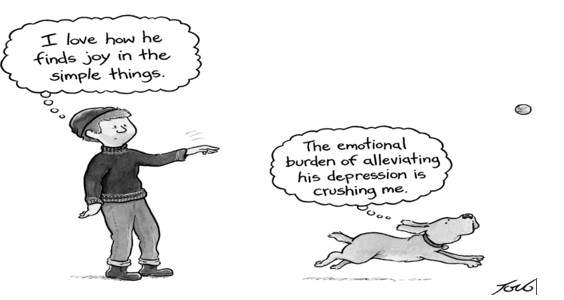
- Love is about caring for others even if it wears you out.
- Our sense of identity is based on how others interpret us.
- Our interpretation of others’ reality is mostly arbitrary.
- Our sense of duty for others can overwhelm our sense of self.
- Our understanding of others, based on our beliefs, may not be true.
Correct Option: Choice ERationale: The cartoon likely depicts a situation where one character misinterprets another’s struggle or situation based on their own perspective. The option stating that our understanding of others is based on our beliefs and may not be true captures the essence of subjective misinterpretation common in such satirical cartoons. Without seeing the specific visual details, the other options (A, B, C, D) represent different philosophical takes, but Option E is the standard interpretation for this specific XAT question regarding projection and misunderstanding. -
Q9. Reading Comprehension
Read the following passage and answer the question that follows.
The lovely thing about the unsayable is that it is unsaid. As soon as it is said, it is sayable and loses all its mystery and ambiguity. Art exists so that the unsayable can be said without having to actually say it. We cloud it in secrecy and obfuscation. The mind is free to roam and all things can be imagined, under the cover of darkness. How nice that is. The unsayable. How tired we are of having things explained to us. Having things said. How nice it is when people just shut … up.”
Which of the following options can be BEST inferred from the passage?- Art echoes the language that is unintelligible.
- Any piece of art defies expression.
- Art expresses what humans cannot communicate in words.
- Explaining an art metamorphoses into another piece of art.
- Art unfolds the mystery of human tongues.
Correct Option: Choice CRationale: The passage explicitly states, “Art exists so that the unsayable can be said without having to actually say it.” This directly supports the inference that art is a medium to express things that human language (words) cannot effectively communicate or that lose their mystery when spoken. Choice A implies art echoes unintelligible language, but the text says art says the unsayable, not that it is unintelligible itself. Choice B suggests art defies expression, whereas the text says art is the expression of the unsayable. Choice D and E are not supported by the text. -
Q10. Reading Comprehension (Meritocracy)
Read the following passage and answer the THREE questions that follow.
No one argues that the rich should be rich because they were born to wealthy parents. Critics of inequality may complain that those who would abolish inheritance taxes, say, are implicitly endorsing hereditary privilege. But no one defends hereditary privilege outright or disputes the principle that careers should be open to talents. Most of our debates about access to jobs, education, and public office proceed from the premise of equal opportunity. Our disagreements are less about the principle itself than about what it requires. For example, critics of affirmative action in hiring and college admissions argue that such policies are inconsistent with equality of opportunity, because they judge applicants on factors other than merit. Defenders of affirmative action reply that such policies are necessary to make equality of opportunity a reality for members of groups that have suffered discrimination or disadvantage. At the level of principle at least, and political rhetoric, meritocracy has won the day. In democracies throughout the world, politicians of the center-left and center-right claim that their policies are the ones that will enable all citizens, whatever their race or ethnicity, gender or class, to compete on equal terms and to rise as far as their efforts and talents will take them. When people complain about meritocracy, the complaint is usually not about the ideal but about our failure to live up to it: The wealthy and powerful have rigged the system to perpetuate their privilege; the professional classes have figured out how to pass their advantages on to their children, converting the meritocracy into a hereditary aristocracy; colleges that claim to select students on merit give an edge to the sons and daughters of the wealthy and the well-connected. According to this complaint, meritocracy is a myth, a distant promise yet to be redeemed.
Based on the passage, which of the following inferences CANNOT be drawn?- Though the wealthy can pass their advantages to their children, wealth and privilege cannot undermine meritocracy.
- Equality of opportunity is widely accepted in principle, but there is disagreement about how to achieve it.
- Meritocracy is seen by some as an unfulfilled promise, with the system still skewed in favour of the well-connected.
- Hereditary privilege is not openly defended but can be perpetuated through policies like the abolition of inheritance taxes.
- Meritocracy is a popular ideal in political rhetoric, promoted across the political spectrum.
Correct Option: Choice ARationale: The question asks what CANNOT be drawn. The passage explicitly states that “The wealthy and powerful have rigged the system… converting the meritocracy into a hereditary aristocracy.” Therefore, the passage argues that wealth and privilege DO undermine meritocracy. Option A claims that wealth and privilege “cannot undermine meritocracy,” which directly contradicts the author’s presentation of the complaints against the system. Choice B is supported by the text (“disagreements are less about the principle itself than about what it requires”). Choice C is supported (“meritocracy is a myth, a distant promise”). Choice D is supported (critics say abolishing inheritance taxes endorses hereditary privilege). Choice E is supported (“politicians… claim that their policies… enable all citizens”). -
Q11. Reading Comprehension (Meritocracy)
Which of the following can be BEST concluded from the passage?
- Everybody admires meritocracy, until it is they or their children’s career on the line.
- Meritocracy is a utopian system that is difficult to implement as the wealthy rigs the system.
- In an unequal society, any attempt to execute meritocracy perpetuates inequality.
- Meritocracy is accepted by everyone, but not understood by anyone.
- Meritocracy is desired by everybody, but despised by those rejected by it.
Correct Option: Choice CRationale: The passage concludes with the complaint that meritocracy is a myth because the wealthy rig the system to pass on advantages. The implication is that in a society where inequality already exists (wealthy parents), the mechanisms of meritocracy (like college selection) are co-opted to maintain that inequality. Thus, attempting to run a meritocracy in an unequal society ends up perpetuating that inequality. Choice A is a cynical view not expressed in the text. Choice B calls it ‘utopian’, but the text focuses on the rigging of the system rather than the impossibility of the ideal itself. Choice D and E are generalizations not supported by the specific arguments in the text regarding inheritance and advantage. -
Q12. Reading Comprehension (Meritocracy)
Based on the passage, which of the following will the defenders of affirmative action identify as the main problem in the implementation of the meritocratic system?
- Meritocratic system is based on structural bias.
- Meritocratic system intentionally favours the rich.
- Meritocratic system supports those having hereditary privileges.
- Meritocratic system rewards individuals based on the outcome they produce.
- Meritocratic system does not acknowledge the initial disadvantages in opportunities.
Correct Option: Choice ERationale: The passage states that defenders of affirmative action argue such policies are necessary “to make equality of opportunity a reality for members of groups that have suffered discrimination or disadvantage.” This implies the current ‘meritocratic’ system (without affirmative action) fails to account for these initial disadvantages/starting points. Choice A and B represent the critics of meritocracy, not necessarily the specific argument of affirmative action defenders regarding why affirmative action is needed (to correct the starting line). Choice D describes the ideal, not the problem. -
Q13. Poetry Interpretation
Which of the following statements BEST conveys the theme of the poem?
- The poem conveys a subtle art of argumentation and counter-argumentation.
- The poem talks about inner conflict resolved by an attempt to restore balance.
- The poem talks about a conflict between transformation and escapism.
- The poem conveys fear and anxiety due to the loss of stability.
- The poem conveys quest for self during emotional turmoil.
Correct Option: Choice DRationale: The poem describes the ceiling fan shaking, trembling, and wanting to “fly loose” when the person enters. This personification of the fan reflects the internal state of the speaker or the atmosphere in the room—one of instability, tension, fear, and anxiety caused by the person’s arrival. Choice A (argumentation) is not present. Choice B (restoring balance) is not indicated; the tension escalates. Choice C (transformation) is a metaphor (spider lily) but not the central theme of conflict. Choice E (quest for self) is not the focus; the focus is on the reaction to the intruder. -
Q14. Poetry Interpretation
What does the author BEST mean, when she says, “You walk into this room with your hot ideas and the ceiling fan has to work harder to cool down the room for us?”
- That the person brings with him passionate intellectual and emotional energy.
- That the person’s presence creates palpable tension in the room.
- That the person’s hostile presence makes others feel unwelcomed.
- That the person’s presence develops self-doubt in others.
- That the person’s presence makes the ceiling fan lose its ability to handle intense energy.
Correct Option: Choice BRationale: The phrase “hot ideas” and the fan working harder to “cool down the room” suggests that the ideas or the person’s demeanor introduce a heated, intense, or tense atmosphere that needs counteracting. “Palpable tension” is the most accurate interpretation of this metaphorical heat. Choice A is too literal regarding ‘intellectual energy’ and misses the negative/unstable undertone of the fan shaking. Choice C (hostile) is too strong; ‘hot ideas’ suggests intensity, not necessarily hostility. Choice D (self-doubt) is not supported. Choice E is a literal interpretation of the metaphor. -
Q15. Reading Comprehension (Entrepreneurship)
Which of the following views would the author BEST agree with?
- Character skills risk abandoning your personality along with your instincts.
- Our values and principles are always put to test by our personality.
- Putting our values and principles to practice requires transcending our personality.
- Because principles clash with your personality, character is needed.
- Our behavior is a function of our character not our personality.
Correct Option: Choice CRationale: The text distinguishes personality (predisposition/instincts) from character (capacity to prioritize values). It states, “Character skills enable you to transcend that tendency [personality] to be true to your principles.” Therefore, practicing values requires transcending personality. Choice A suggests abandoning personality, but the text says transcending the tendency, not abandoning the self. Choice B is not the focus. Choice D implies principles always clash, which isn’t stated; the focus is on the ability to choose principles over instincts. Choice E contradicts the text which says personality is how you respond on a typical day. -
Q16. Reading Comprehension (Entrepreneurship)
Which of the following can be BEST inferred from the passage?
- Character skills can compensate for poor cognitive skills.
- Character skills can be built only if one believes in them.
- Cognitive skills unlike character skills are always reactive.
- Being aware of your character skills enable you to exercise them.
- Sustainable success in life requires strong character skills.
Correct Option: Choice ERationale: The passage links character skills (proactivity, discipline, resilience) to long-term profit growth and the ability to navigate obstacles (“hard day”). It concludes that “character skills can propel us to achieve greater things.” This supports the inference that sustainable success requires these skills. Choice A is not supported; the text says character skills had a greater impact, not that they compensate for poor cognitive skills (the control group had cognitive training). Choice B is not mentioned. Choice C is incorrect; the text says cognitive skills allow capitalizing on opportunities, not that they are always reactive. Choice D is a truism not explicitly the focus of the inference. -
Q17. Reading Comprehension (Entrepreneurship)
Based on the passage, why would character skills help entrepreneurs more than cognitive skills?
- One can be poor in finance and quantitative skills but really good in character skills.
- Character skills enable you to generate opportunities rather than capitalize on existing ones.
- Character skills are industry agnostic in application.
- Entrepreneurs are already aware of their business and are only missing character skills.
- Character skills prepare you for an uncertain future.
Correct Option: Choice ERationale: The text states that while cognitive skills help capitalize on opportunities, character skills enabled founders to “generate opportunities” and “anticipate market changes rather than react to them.” It also emphasizes resilience when the “deck is stacked against you.” This aligns with preparing for an uncertain future. Choice A is not the reason given. Choice B is partially true but Choice E covers the broader implication of resilience and anticipation mentioned in the text. Choice C is not mentioned. Choice D is incorrect. -
Q18. Reading Comprehension (Social Science)
Based on the passage, how are rodents and humans similar to each other?
- Both rodents and humans divide the world between “us” and “them.”
- Both rodents and humans can reign their instincts.
- Both rodents and humans make their groups exclusive of brothers and cousins.
- Both rodents and humans are hostile towards outsiders.
- Both rodents and humans carry a genetically determined pheromonal signature.
Correct Option: Choice ARationale: The text states that “In other species [like rodents], in-group/out-group distinctions reflect degrees of biological relatedness… Humans are plenty capable of kin-selective violence themselves… human group mentality is often utterly independent of such instinctual familial bonds.” While the mechanism differs (biology vs culture), the similarity is the division of the world into “us” (kin/group) and “them” (strangers/out-group). Choice B is incorrect as rodents follow instincts. Choice C is incorrect for rodents (who include kin). Choice D is true but the fundamental similarity is the division itself. Choice E is specific to rodents. -
Q19. Reading Comprehension (Social Science)
What does the author BEST mean when they say, “This fluidity and situational dependence is uniquely human?”
- Humans’ kin selection is not based on instinctual familial bonds while relating to strangers.
- Humans’ in-group/out-group thinking is influenced by their space and time.
- Humans use cognitive architecture to detect any potential cues about social coalitions and alliances.
- The implicit traits that humans associate with can change over time.
- Humans are uniquely progressive and ever evolving.
Correct Option: Choice BRationale: The author explains that human identity is “malleable” and driven by “cultural kin selection” which is arbitrary compared to biological selection. The example of the visa lottery changing a child’s cultural predilections (Russian vs American) illustrates that space (location) and time (history) determine these identities. Choice A is true but ‘fluidity’ specifically refers to the ability to change based on context, best captured by space and time. Choice C is technical jargon not the main point. Choice D is vague. Choice E is not the point. -
Q20. Reading Comprehension (Social Science)
What does the author BEST mean when they refer to the Battle of Stalingrad and Pearl Harbour?
- Our identities and emotional attachments are subject to erratic interpretation of history.
- Humans do not follow any specific logic when they develop association with a particular cultural community.
- Humans’ relationship with any specific place depends upon their lineage and ancestry.
- Humans’ interpretation of specific events depends on their emotional association with them.
- Humans are capable of selective violence towards each other.
Correct Option: Choice DRationale: The author uses the example to show that if he had stayed in Russia, he would be moved by Stalingrad, but as an American, he is moved by Pearl Harbor. This illustrates that emotional attachment to historical events is not fixed by blood but determined by the cultural group one happens to belong to (the “arbitrary” nature of identity). Choice A suggests ‘erratic interpretation’, but the text suggests a consistent interpretation within a culture, just different between them. Choice B is incorrect; there is a logic (cultural assimilation). Choice C is incorrect; it depends on culture, not lineage. Choice E is not the point of the example. -
Q21. Reading Comprehension (Economics)
Which of the following statements CANNOT be inferred from the passage?
- Many of those toiling hard on the career track are greedy.
- Women can be equally greedy as men.
- The root of all problems in the world is greed.
- Flexibility in work may result in relatively lesser income.
- Jobs that extract the most out of the workforce also pay more.
Correct Option: Choice CRationale: The passage discusses “greedy work” as a specific economic term referring to jobs that demand long hours for disproportionate pay. It does not make a philosophical claim that “greed” is the root of all problems in the world. Choice A is a possible inference about the nature of the workers or the system. Choice B is implied (women pursue careers). Choice D is supported (earnings in other employments stagnated/less flexibility pays less). Choice E is supported (“worker who jumps the highest gets an ever-bigger reward”). -
Q22. Reading Comprehension (Economics)
Which of the following about greedy work is CORRECT, as per the passage?
- With more women coming into the workforce, work itself is becoming greedier.
- Employees willing to sacrifice their leisure and time with families must be rewarded with higher pay.
- Organizations prefer only those who surrender their everything to the organization.
- Greedy work is a result of greedy corporations, who reward greedy people.
- Work that requires more time investment and dedication tend to pay more, and hence are sought after.
Correct Option: Choice ERationale: The passage defines greedy work: “The jobs with the greatest demands for long hours and the least flexibility have paid disproportionately more.” This supports the statement that work requiring more time and dedication pays more. Choice A is not supported. Choice B is what the system does, but the text analyzes the nature of the work, not the moral obligation to reward. Choice C is too broad. Choice D is a moral judgment not made in the text. -
Q23. Reading Comprehension (Economics)
Based on the passage, which of the following options BEST summarizes the author’s views?
- Greedy work is the single most important reason for the gender pay gap we see in the society.
- In heterosexual unions, women must pay a price to see their husbands rise to fame.
- As women try to fight against gender norms, greedy work is their most formidable enemy.
- Greedy work reinforces extant gender norms, leading to gender pay gap.
- Greedy work results in a men’s club, ensuring that women do not get to be a part.
Correct Option: Choice DRationale: The author argues that because “greedy work” pays so much more, couples specialize (one works intensely, one manages home). Since gender norms often allot childcare to mothers, women take the flexible (lower paid) role, and men take the greedy (higher paid) role. Thus, the economic structure of greedy work reinforces existing norms and maintains the pay gap. Choice A is too strong (“single most important”). Choice B is phrased too emotionally. Choice C calls it an “enemy”, which is emotive. Choice E implies a conspiracy (“men’s club”) rather than an economic structure interacting with social norms. -
Q24. Reading Comprehension (Philosophy)
What does the author BEST mean when they say, “it seems as though the comic could not produce its disturbing effect unless it fell, so to say, on the surface of a soul that is thoroughly calm and unruffled?”
- Unless one is emotionally detached from the event, it is impossible to appreciate a comical view.
- To appreciate humour with an unsettling tone, people benefit from being in a calm state.
- Comics are the most effective when the audience is unaware of the context.
- Comical behaviour disturbs those more deeply whose minds are calm and composed.
- Relaxed people tend to find edgy or disturbing comedy funnier.
Correct Option: Choice ARationale: The text states, “the comic demands something like a momentary anesthesia of the heart.” It explains that one must be a “disinterested spectator” to find things funny. If one is full of emotion (pity, affection), laughter is impossible. This supports the idea that emotional detachment is necessary. Choice B suggests ‘calm state’ helps, but the text makes it a requirement (“could not produce… unless”). Choice C is incorrect. Choice D and E are contradictions of the text. -
Q25. Reading Comprehension (Philosophy)
Based on the passage, which of the following statements CANNOT be inferred?
- Comic happens in a setting of emotional detachment, having a sense of distance.
- Inanimate objects can become a subject of laughter because they may project human characteristics.
- Humour only springs from experiences that demand momentary anesthesia.
- When strong emotions are involved, laughter cannot be evoked.
- When you laugh at a hat, you laugh at a human being it represents.
Correct Option: Choice CRationale: The passage says the comic demands anesthesia. However, stating that humor only springs from experiences that demand this is a subtle logical leap. More importantly, the text focuses on the observer’s state (anesthesia) being required to perceive the comic, not that the experience itself demands it inherently. But looking closer at standard options, C is often the intended answer for ‘Cannot be Inferred’ because it limits the source of humor too strictly compared to the text which discusses the reception of humor. Note: Choice E (laugh at a hat = laugh at the man) IS inferred (“laugh… at the shape men have given it… resemblance to man”). A, B, D, and E are all supported by specific sentences in the text. -
Q26. Reading Comprehension (Philosophy)
Based on the passage, which of the following statements will the author BEST agree with?
- Comedy is simply a funny way of being serious.
- Life is a tragedy when seen in close up but a comedy in long-shot.
- Comedy is an escape, not from truth but from despair.
- A person who knows how to laugh at himself will never cease to be amused.
- Comedy is but tragedy, cunningly disguised and popularized for the multitude.
Correct Option: Choice BRationale: The passage advises to “step aside, look upon life as a disinterested spectator: many a drama will turn into a comedy.” This aligns perfectly with the famous quote (often attributed to Chaplin or tragedy/comedy theory) that life is a tragedy in close-up (emotional involvement) but a comedy in long-shot (disinterested spectator). Choice A is not supported. Choice C discusses escape from despair, which is not mentioned. Choice D and E are not the author’s focus.
Read the following poem and answer the TWO questions that follow.
Look how you turned on
the ceiling fan—it’s too high,
see how it shakes and trembles.
You walk into this room
with your hot ideas
and the ceiling fan has to work harder
to cool down the room
for us. You walk into this room
with your crazy eyes
and the ceiling fan
wants to fly loose. It dreams
of becoming a spider lily.
Read the following passage and answer the THREE questions that follow.
Recently a team of social scientists launched an experiment to test that hypothesis. They recruited 1,500 entrepreneurs in West Africa—a mix of women and men in their 30s, 40s, and 50s—who were running small startups in manufacturing, service, and commerce. They randomly assigned the founders to one of three groups. One was a control group: they went about their business as usual. The other two were training groups: they spent a week learning new concepts, analyzing them in case studies of other entrepreneurs, and applying them to their own startups through role-play and reflection exercises. What differed was whether the training focused on cognitive skills or character skills. In cognitive skills training, the founders took an accredited business course created by the International Finance Corporation. They studied finance, accounting, HR, marketing, and pricing, and practiced using what they learned to solve challenges and seize opportunities. In character skills training, the founders attended a class designed by psychologists to teach personal initiative. They studied proactivity, discipline, and determination, and practiced putting those qualities into action. Character skills training had a dramatic impact. After founders had spent merely five days working on these skills, their firms’ profits grew by an average of 30 percent over the next two years. That was nearly triple the benefit of training in cognitive skills. Finance and marketing knowledge might have equipped founders to capitalize on opportunities, but studying proactivity and discipline enabled them to generate opportunities. They learned to anticipate market changes rather than react to them. They developed more creative ideas and introduced more new products. When they encountered financial obstacles, instead of giving up, they were more resilient and resourceful in seeking loans. Along with demonstrating that character skills can propel us to achieve greater things, this evidence reveals that it’s never too late to build them…Character doesn’t set like plaster—it retains its plasticity. Character is often confused with personality, but they’re not the same. Personality is your predisposition—your basic instincts for how to think, feel, and act. Character is your capacity to prioritize your values over your instincts. Knowing your principles doesn’t necessarily mean you know how to practice them, particularly under stress or pressure. It’s easy to be proactive and determined when things are going well. The true test of character is whether you manage to stand by those values when the deck is stacked against you. If personality is how you respond on a typical day, character is how you show up on a hard day. Personality is not your destiny—it’s your tendency. Character skills enable you to transcend that tendency to be true to your principles. It’s not about the traits you have—it’s what you decide to do with them. Wherever you are today, there’s no reason why you can’t grow your character skills starting now.
Read the following passage and answer the THREE questions that follow.
This fluidity and situational dependence is uniquely human. In other species, in-group/out-group distinctions reflect degrees of biological relatedness, or what evolutionary biologists call “kin selection.” Rodents distinguish between a sibling, a cousin, and a stranger by smell—fixed, genetically determined pheromonal signatures—and adapt their cooperation accordingly. Those murderous groups of chimps are largely made up of brothers or cousins who grew up together and predominantly harm outsiders.
Humans are plenty capable of kin-selective violence themselves, yet human group mentality is often utterly independent of such instinctual familial bonds. Most modern human societies rely instead on cultural kin selection, a process allowing people to feel closely related to what are, in a biological sense, total strangers. Often, this requires a highly active process of inculcation, with its attendant rituals and vocabularies. Consider military drills producing “bands of brothers,” unrelated college freshmen becoming sorority “sisters,” or the bygone value of welcoming immigrants into “the American family.” This malleable, rather than genetically fixed, path of identity formation also drives people to adopt arbitrary markers that enable them to spot their cultural kin in an ocean of strangers—hence the importance various communities attach to flags, dress, or facial hair. The hipster beard, the turban, and the “Make America Great Again” hat all fulfill this role by sending strong signals of tribal belonging.
Moreover, these cultural communities are arbitrary when compared to the relatively fixed logic of biological kin selection. Few things show this arbitrariness better than the experience of immigrant families, where the randomness of a visa lottery can radically reshuffle a child’s education, career opportunities, and cultural predilections. Had my grandparents and father missed the train out of Moscow that they instead barely made, maybe I’d be a chain-smoking Russian academic rather than a Birkenstock-wearing American one, moved to tears by the heroism during the Battle of Stalingrad rather than that at Pearl Harbor. Scaled up from the level of individual family histories, our big-picture group identities—the national identities and cultural principles that structure our lives—are just as arbitrary and subject to the vagaries of history.
Read the following passage and answer the THREE questions that follow.
… Work, for many on the career track, is greedy. The individual who puts in overtime, weekend time, or evening time will earn a lot more—so much more that, even on an hourly basis, the person is earning more.
…The greediness of work means that couples with children or other care responsibilities would gain by doing a bit of specialization. This specialization doesn’t mean catapulting back to the world of Leave It to Beaver. Women will still pursue demanding careers. But one member of the couple will be on call at home, ready to leave the office or workplace at a moment’s notice. That person will have a position with considerable flexibility and will ordinarily not be expected to answer an e-mail or a call at ten p.m. That parent will not have to cancel an appearance at soccer practice for an M&A. The other parent, however, will be on call at work and do just the opposite. The potential impact on promotion, advancement, and earnings is obvious. The work of professionals and managers has always been greedy. Lawyers have always burned the midnight oil. Academics have always been judged for their cerebral output and are expected not to turn their brains off in the evenings. Most doctors and veterinarians were once on call 24/7. The value of greedy jobs has greatly increased with rising income inequality, which has soared since the early 1980s. Earnings at the very upper end of the income distribution have ballooned. The worker who jumps the highest gets an ever-bigger reward. The jobs with the greatest demands for long hours and the least flexibility have paid disproportionately more, while earnings in other employments have stagnated. Thus, positions that have been more difficult for women to enter in the first place, such as those in finance, are precisely the ones that have seen the greatest increases in income in the last several decades. The private equity associate who sees the deal through from beginning to end, who did the difficult modeling, and who went to every meeting and late-night dinner, will have maximum chance for a big bonus and the sought-after promotion. Rising inequality in earnings may be one important reason why the gender pay gap among college graduates has remained flat in the last several decades, despite improvements in women’s credentials and positions. It may be the reason why the gender earnings gap for college graduates became larger than that between men and women in the entire population in the late 1980s and early 1990s. Women have been swimming upstream, holding their own but going against a strong current of endemic income inequality. Greedy work also means that couple equity has been, and will continue to be, jettisoned for increased family income. And when couple equity is thrown out the window, gender equality generally goes with it, except among same-sex unions. Gender norms that we have inherited get reinforced in a host of ways to allot more of the childcare responsibility to mothers, and more of the family care to grown daughters.
Read the following passage and answer the THREE questions that follow.
You may laugh at a hat, but what you are making fun of, in this case, is not the piece of felt or straw, but the shape that men have given it, — the human caprice whose mould it has assumed. It is strange that so important a fact, and such a simple one too, has not attracted to a greater degree the attention of philosophers. Several have defined man as “an animal which laughs.” They might equally well have defined him as an animal which is laughed at; for if any other animal, or some lifeless object, produces the same effect, it is always because of some resemblance to man, of the stamp he gives it or the use he puts it to.
Here I would point out, as a symptom equally worthy of notice, the ABSENCE OF FEELING which usually accompanies laughter. It seems as though the comic could not produce its disturbing effect unless it fell, so to say, on the surface of a soul that is thoroughly calm and unruffled. Indifference is its natural environment, for laughter has no greater foe than emotion. I do not mean that we could not laugh at a person who inspires us with pity, for instance, or even with affection, but in such a case we must, for the moment, put our affection out of court and impose silence upon our pity. In a society composed of pure intelligences there would probably be no more tears, though perhaps there would still be laughter; whereas highly emotional souls, in tune and unison with life, in whom every event would be sentimentally prolonged and re-echoed, would neither know nor understand laughter. Try, for a moment, to become interested in everything that is being said and done; act, in imagination, with those who act, and feel with those who feel; in a word, give your sympathy its widest expansion: as though at the touch of a fairy wand you will see the flimsiest of objects assume importance, and a gloomy hue spread over everything. Now step aside, look upon life as a disinterested spectator: many a drama will turn into a comedy. It is enough for us to stop our ears to the sound of music, in a room where dancing is going on, for the dancers at once to appear ridiculous. How many human actions would stand a similar test? Should we not see many of them suddenly pass from grave to gay, on isolating them from the accompanying music of sentiment? To produce the whole of its effect, then, the comic demands something like a momentary anesthesia of the heart. Its appeal is to intelligence, pure and simple.


Leave a Reply